Immanuel Kant
Philosopher
1724-04-22 – 1804-02-12
Immanuel Kant was a German philosopher of the Enlightenment whose work transformed modern epistemology, ethics, and metaphysics. He is best known for the Critique of Pure Reason and for his formulation of the categorical imperative.
Books by Immanuel Kant
-

Kritik der reinen Vernunft
View on Amazon -
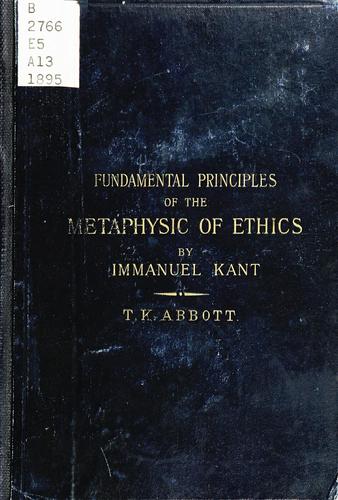
Grundlegung zur Metaphysik der Sitten
View on Amazon -

Kritik der Urteilskraft
View on Amazon
As an Amazon Associate we earn from qualifying purchases.
Quotes by Immanuel Kant
-
The touchstone of everything that can be concluded as a law for a people lies in the question whether the people could have imposed such a law on itself.
Read quote -
...[N]ature generally in the distribution of her capacities has adapted the means to the end... [so nature's] true destination must be to produce a will, not merely good as a means to something else, but good in itself, for which reason was... imparted to us as a practical... absolutely necessary... faculty.
Read quote -
In the physical constitution of an organized being, that is, a being adapted suitably to the purposes of life, we assume it as a fundamental principle that no organ for any purpose will be found but what is also the fittest and best adapted for that purpose. Now in a being which has reason and a will, if the proper object of nature were its conservation, its welfare, in a word, its happiness, then nature would have hit upon a very bad arrangement in selecting the reason of the creature to carry out this purpose. For all the actions which the creature has to perform with a view to this purpose, and the whole rule of its conduct, would be far more surely prescribed to it by instinct, and that end would have been attained thereby much more certainly that it ever can be by reason. Should reason have been communicated to this favored creature over and above, it must only have served it to contemplate the happy constitution of its nature, to admire it, to congratulate itself thereon, and to feel thankful for it to the beneficent cause, but not that it should subject its desires to that weak and delusive guidance, and meddle bunglingly with the purpose of nature. In a word, nature would have taken care that reason should not break forth into practical exercise, nor have the presumption, with its weak insight, to think out for itself the plan of happiness and the means of attaining it. Nature would not only have taken on herself the choice of the ends but also of the means, and with wise foresight would have entrusted both to instinct.
Read quote -
Laziness and cowardice are the reasons why so great a portion of mankind, after nature has long since discharged them from external direction (naturaliter maiorennes), nevertheless remains under lifelong tutelage, and why it is so easy for others to set themselves up as their guardians. It is so easy not to be of age. If I have a book which understands for me, a pastor who has a conscience for me, a physician who decides my diet, and so forth, I need not trouble myself. I need not think, if I can only pay - others will easily undertake the irksome work for me.That the step to competence is held to be very dangerous by the far greater portion of mankind...
Read quote -
Act in such a way that you treat humanity, whether in your own person or in the person of any other, never merely as a means to an end, but always at the same time as an end.
Read quote -
From the crooked timber of humanity, a straight board cannot be hewn.
Read quote -
Out of the crooked timber of humanity, no straight thing was ever made.
Read quote -
In all judgements by which we describe anything as beautiful, we allow no one to be of another opinion.
Read quote -
The enjoyment of power inevitably corrupts the judgement of reason, and perverts its liberty.
Read quote -
It must be freely admitted that there is a sort of circle here from which it seems impossible to escape. In the order of efficient causes we assume ourselves free, in order that in the order of ends we may conceive ourselves as subject to these laws because we have attributed to ourselves freedom of will; for freedom and self-legislation of will are both autonomy...
Read quote -
As nature has uncovered from under this hard shell the seed for which she most tenderly cares - the propensity and vocation to free thinking - this gradually works back upon the character of the people, who thereby gradually become capable of managing freedom; finally, it affects the principles of government, which finds it to its advantage to treat men, who are now more than machines, in accordance with their dignity.
Read quote -
...[F]reedom... is a property of all rational beings.
Read quote -
...new prejudices will serve as well as old ones to harness the great unthinking masses.For this enlightenment, however, nothing is required but freedom, and indeed the most harmless among all the things to which this term can properly be applied. It is the freedom to make public use of one's reason at every point. But I hear on all sides, 'Do not argue!' The Officer says: 'Do not argue but drill!' The tax collector: 'Do not argue but pay!' The cleric: 'Do not argue but believe!' Only one prince in the world says, 'Argue as much as you will, and about what you will, but obey!' Everywhere there is restriction on freedom.
Read quote -
Here then we see philosophy brought to a critical position, since it has to be firmly fixed, notwithstanding that it has nothing to support it in heaven or earth. Here it must show its purity as absolute director of its own laws, not the herald of those which are whispered to it by an implanted sense or who knows what tutelary nature. Although these may be better than nothing, yet they can never afford principles dictated by reason, which must have their source wholly a priori and thence their commanding authority, expecting everything from the supremacy of the the law and due respect for it, nothing from inclination, or else condemning the man to self-contempt and inward abhorrence.
Read quote -
...[P]hysics... [is] the philosophy of nature, so far as it is based on empirical laws.
Read quote -
...[R]eason of itself, independent on all experience, ordains what ought to take place, that accordingly actions of which perhaps the world has hitherto never given an example, the feasibility even if which might be very much doubted by one who founds everything on experience, are nevertheless inflexibly commanded by reason; that, for example, even though there might never yet have been a sincere friend, yet not a whit the less is pure sincerity in friendship required of every man...
Read quote -
In every department of physical science there is only so much science, properly so-called, as there is mathematics.
Read quote -
Two things fill the mind with ever new and increasing admiration and awe, the more often and steadily we reflect upon them: the starry heavens above me and the moral law within me. I do not seek or conjecture either of them as if they were veiled obscurities or extravagances beyond the horizon of my vision; I see them before me and connect them immediately with the consciousness of my existence.
Read quote -
Treat people as an end, and never as a means to an end
Read quote -
If I have a book that thinks for me, a pastor who acts as my conscience, a physician who prescribes my diet, and so on... then I have no need to exert myself. I have no need to think, if only I can pay; others will take care of that disagreeable business for me.
Read quote