Michael Pollan
Books by Michael Pollan
-
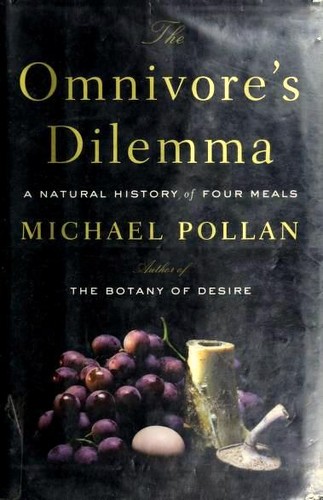
Omnivore's Dilemma. A Natural History of Four Meals
View on Amazon -

-

In Defense of Food
View on Amazon
As an Amazon Associate we earn from qualifying purchases.
Quotes by Michael Pollan
-
One problem with the division of labor in our complex economy is how it obscures the lines of connection, and therefore of responsibility, between our everyday acts and their real-world consequences. Specialization makes it easy to forget about the filth of the coal-fired power plant that is lighting this pristine computer screen, or the back-breaking labor it took to pick the strawberries for my cereal, or the misery of the hog that lived and died so I could enjoy my bacon. Specialization neatly hides our implication in all that is done on our behalf by unknown other specialists half a world away.
Read quote -
The shared meal elevates eating from a mechanical process of fueling the body to a ritual of family and community, from the mere animal biology to an act of culture.
Read quote -
If you stand in a wheat field at this time of year, a few weeks from harvest, it's not hard to imagine you're looking at something out of mythology: all this golden sunlight brought down to earth, captured in kernels of gold, and rendered fit for mortals to eat. But of course this is no myth at all, just the plain miraculous fact.
Read quote -
The more serious about gardening I became, the more dubious lawns seemed. The problem for me was not, as it was for my father, the relation to my neighbors that a lawn implied; it was the lawn's relationship to nature. For however democratic a lawn may be with respect to one's neighbors, with respect to nature it is authoritarian. Under the mower's brutal indiscriminate rotor, the landscape is subdued, homogenized, dominated utterly. I became convinced that lawn care had about as much to do with gardening as floor waxing, or road paving. Gardening was a subtle process of give and take with the landscape, a search for some middle ground between culture and nature. A lawn was nature under culture's boot.Mowing the lawn, I felt like I was battling the earth rather than working it; each week it sent forth a green army and each week I beat it back with my infernal machine. Unlike every other plant in my garden, the grasses were anonymous, massified, deprived of any change or development whatsoever, not to mention any semblance of self-determination. I ruled a totalitarian landscape.Hot monotonous hours behind the mower gave rise to existential speculations. I spent part of one afternoon trying to decide who, in the absurdist drama of lawn mowing, was Sisyphus. Me? A case could certainly be made. Or was it the grass, pushing up through the soil every week, one layer of cells at a time, only to be cut down and then, perversely, encouraged (with fertilizer, lime, etc.) to start the whole doomed process over again? Another day it occurred to me that time as we know it doesn't exist in the lawn, since grass never dies or is allowed to flower and set seed. Lawns are nature purged of sex and death. No wonder Americans like them so much.
Read quote -
Each spring for a period of weeks the imperial gardens were filled with prize tulips (Turkish, Dutch, Iranian), all of them shown to their best advantage. Tulips whose petals had flexed wide were held shut with fine threads hand-tied. Most of the bulbs had been grown in place, but these were supplemented by thousands of cut stems held in glass bottles; the scale of the display was further compounded by mirrors placed strategically around the garden. Each variety was marked with a label made from silver filigree. In place of every fourth flower a candle, its wick trimmed to tulip height, was set into the ground. Songbirds in gilded cages supplied the music, and hundreds of giant tortoises carrying candles on their backs lumbered through the gardens, further illuminating the display. All the guests were required to dress in colors that flattered those of the tulips. At the appointed moment a cannon sounded, the doors to the harem were flung open, and the sultan's mistresses stepped into the garden led by eunuchs bearing torches. The whole scene was repeated every night for as long as the tulips were in bloom, for as long as Sultan Ahmed managed to cling to his throne.
Read quote -
In the same way that the picturesque designers were always careful to include some reminder of our mortality in their gardens -- a ruin, sometimes even a dead tree -- the act of leaving parts of the garden untended, and calling attention to its margins, seems to undermine any pretense to perfect power or wisdom on the part of the gardener. The margins of our gardens can be tropes too, but figures of irony rather than transcendence -- antidotes, in fact, to our hubris. It may be in the margins of our gardens that we can discover fresh ways to bring our aesthetics and our ethics about the land into some meaningful alignment.
Read quote -
Seeds have the power to preserve species, to enhance cultural as well as genetic diversity, to counter economic monopoly and to check the advance of conformity on all its many fronts.
Read quote -
The garden suggests there might be a place where we can meet nature halfway.
Read quote -
Anthropocentric as [the gardener] may be, he recognizes that he is dependent for his health and survival on many other forms of life, so he is careful to take their interests into account in whatever he does. He is in fact a wilderness advocate of a certain kind. It is when he respects and nurtures the wilderness of his soil and his plants that his garden seems to flourish most. Wildness, he has found, resides not only out there, but right here: in his soil, in his plants, even in himself...But wildness is more a quality than a place, and though humans can't manufacture it, they can nourish and husband it...The gardener cultivates wildness, but he does so carefully and respectfully, in full recognition of its mystery.
Read quote -
Don't eat anything your great-grandmother wouldn't recognize as food.
Read quote -
Tree planting is always a utopian enterprise, it seems to me, a wager on a future the planter doesn't necessarily expect to witness.
Read quote -
It has become much harder, in the past century, to tell where the garden leaves off and pure nature begins.
Read quote -
People have traditionally turned to ritual to help them frame and acknowledge and ultimately even find joy in just such a paradox of being human - in the fact that so much of what we desire for our happiness and need for our survival comes at a heavy cost. We kill to eat, we cut down trees to build our homes, we exploit other people and the earth. Sacrifice - of nature, of the interests of others, even of our earlier selves - appears to be an inescapable part of our condition, the unavoidable price of all our achievements. A successful ritual is one that addresses both aspects of our predicament, recalling us to the shamefulness of our deeds at the same time it celebrates what the poet Frederick Turner calls the beauty we have paid for with our shame. Without the double awareness pricked by such rituals, people are liable to find themselves either plundering the earth without restraint or descending into self-loathing and misanthropy. Perhaps it's not surprising that most of us today bring one of those attitudes or the other to our conduct in nature.
Read quote -
Cooking gave us not just the meal but also the occasion: the practice of eating together at an appointed time and place. This was something new under the sun, for the forager of raw food would have likely fed himself on the go and alone, like all the other animals. (Or, come to think of it, like the industrial eaters we've more recently become, grazing at gas stations and eating by ourselves whenever and wherever.) But sitting down to common meals, making eye contact, sharing food, and exercising self-restraint all served to civilize us.
Read quote -
It seems that by the time the singular beauty of a flower in bloom can no longer pierce the veil of black or obsessive thoughts in a person's mind, that mind's connection to the sensual world has grown dangerously frayed.
Read quote -
How did these organs of plant sex manage to get themselves cross-wired with human ideas of value and status and Eros? And what might our ancient attraction for flowers have to teach us about the deeper mysteries of beauty - what one poet has called this grace wholly gratuitous? Is that what it is? Or does beauty have a purpose? (64)
Read quote -
But that's the challenge -- to change the system more than it changes you.
Read quote -
we ask for too much salvation by legislation. All we need to do is empower individuals with the right philosophy and the right information to opt out en masse. (quoting Joel Salatin)
Read quote -
Eating is an agricultural act,' as Wendell Berry famously said. It is also an ecological act, and a political act, too. Though much has been done to obscure this simple fact, how and what we eat determines to a great extent the use we make of the world - and what is to become of it. To eat with a fuller consciousness of all that is at stake might sound like a burden, but in practice few things in life can afford quite as much satisfaction. By comparison, the pleasures of eating industrially, which is to say eating in ignorance, are fleeting. Many people today seem erfectly content eating at the end of an industrial food chain, without a thought in the world; this book is probably not for them.
Read quote -
[Government] regulation is an imperfect substitute for the accountability, and trust, built into a market in which food producers meet the gaze of eaters and vice versa.
Read quote